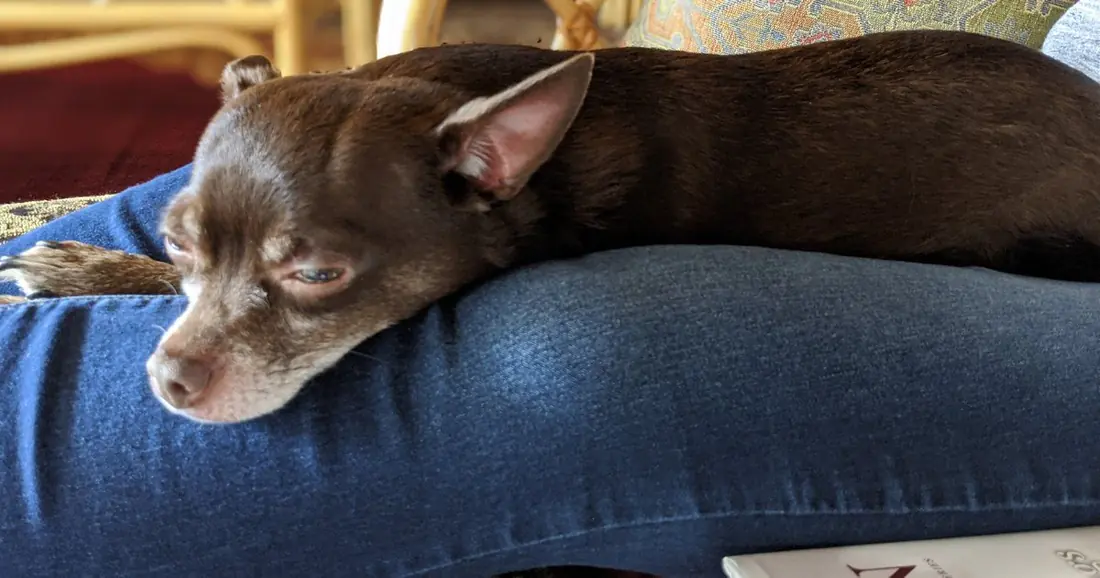
Why Does My Dog Sit on Me? 6 Reasons, Read the Moment
By Dog Translator · · 6 min read
Your dog has a bed, a couch and an entire floor, and it chooses you. Sitting on your lap, plopping on your feet and leaning its full weight into your legs are versions of the same thing: contact. AKC's Dr. Mary Burch calls a dog sitting on your feet 'the canine version of a hug or cuddle'. That covers most cases. The rest are about warmth, nerves, a sore body or guarding, and the moment it happens usually tells you which.
Read the moment
| When it happens | Most likely reason | Do anything? |
|---|---|---|
| Evening on the couch | Closeness and comfort | No |
| Cold or damp day | Warmth | No |
| At the vet, during storms, in new places | Seeking security | Help with the fear, not the sitting |
| At the dog park, by your feet | Staying close, sometimes claiming you | Watch for stiffness toward other dogs |
| When a guest or partner comes near | Possible guarding of you | Yes, if it stiffens or growls |
| Older dog, always the same raised spot | Easier on the joints | Check with your vet |
1. Closeness
The plain answer is that your dog likes being in contact with you. Dogs form genuine attachment bonds with their owners, and physical closeness is one way that bond shows up day to day. Contact also gets rewarded: when a dog sits on you, you usually pet it, talk to it and rub its ears. AKC notes that this attention makes dogs more likely to repeat the move. Nothing wrong with that.
2. Warmth
Burch points out that in cold or damp weather, dogs settle on owners' slippers and laps to stay warm, a habit that probably goes back to puppies piling together in the litter. Small, short-coated breeds like the Chihuahua feel the cold fastest, which is part of why so many of them treat a lap as their home address. AKC also mentions that small breeds were historically used as foot warmers.
3. Reassurance
A dog that suddenly sits on your feet in a new place, at the vet or during fireworks is using you as a safe base. AKC lists the fear signs to look for at the same time: drooling, shaking, panting, crouching, a tail tucked under, the head hanging and ears pulled back. If you see those, the sitting is not the issue. The fear is. Stay calm, let the dog stay close, and work on the trigger later.
4. Claiming you
At the dog park, Burch says, a dog sitting on its owner's feet may be signaling to other dogs that this is its person. In mild form this is harmless. It becomes a problem when the dog gets stiff, stares or growls at people or dogs who approach you. AKC's advice on dogs sharing the bed makes the same point: dogs can become overprotective of one partner and growl at the other person trying to get in. That is guarding, and it is worth addressing early.
- •Signs it is guarding: the dog freezes, its body stiffens, it stares hard at the approaching person, it growls or lifts a lip.
- •What to do: calmly stand up so the dog slides off, and let it earn the spot back with an invitation. Keep furniture access 'by invitation only' for a while.
- •What not to do: punish the growl. That removes the warning, not the feeling. Our growling guide explains why.
5. A sore body
This one surprises people. AKC notes that arthritic dogs may prefer sitting on your feet or another raised spot because they do not have to bend as far to sit. If an older dog has started perching on you or the edge of things, and also seems stiff getting up, mention it to your vet. Our guide on dogs groaning when you pet them covers the other pain clues.
6. It wants something
A dog that climbs into your lap at 5:55 p.m. every day is not only being affectionate. It knows dinner is at six. Burch's own trick for moving a dog off someone's feet is to say the word 'treat', which tells you how food-motivated this behavior can be.
One more version of this: the dog that sits on you the moment you sit down to work, eat or watch something. You have just become still and interesting, and the dog has learned that stillness means lap time. If that is not convenient, give it a chew on its bed as you sit down, before it has a chance to climb up.
Is it dominance?
No. Sitting on you is not a dog trying to rank above you. That idea has been dropped by most behavior experts. Even the guarding case is about a dog wanting to keep access to something it values, not about status. Treat it like any other guarding: manage access and change how the dog feels about people approaching.
Big dogs who think they are lap dogs
Large breeds sit on people too, and with a Great Dane or a Golden Retriever the result can be uncomfortable. If you want to keep the closeness without the weight, teach a 'place' cue on a bed right next to your chair and reward the dog heavily for lying there touching your feet. You keep the contact and save your knees.
Puppies and newly adopted dogs
Puppies pile onto people the way they piled onto littermates, and a newly adopted dog often glues itself to its new person for the first weeks. Both are normal. With a new dog, give it plenty of contact while also building short periods of rest on its own bed nearby, so the closeness does not turn into the only way it can relax.
Teaching an 'off' that sticks
- While the dog is on your lap, toss a treat onto the floor and say 'off' as it jumps down to get it.
- Repeat until the dog starts to hop off as soon as it hears the word, then give the treat after it lands.
- Invite it back up with a different cue, such as 'up', so getting on and off both happen on your terms.
- Use the same cue for furniture and beds. Consistency across the house is what makes it stick.
An 'off' cue is useful even if you love lap time. It lets you move the dog without pushing or pulling, which matters most with dogs that might guard their spot.
Should you let your dog sit on you?
For most dogs, yes. It is one of the easiest ways to give a dog the contact it is asking for. Make it a habit you control: invite the dog up, and have it get down on cue. Two situations call for a change. If the dog guards you, see the section above. If the dog cannot settle unless it is touching you, and panics when it cannot reach you, that is closer to separation anxiety than affection, and our guide on dogs that follow you everywhere has a checklist. Small breeds like the Pug and Chihuahua get away with being permanent lap residents. That is fine, as long as they can also be comfortable on their own.
Frequently asked questions
Why does my dog sit on me instead of next to me?
Mostly for closeness and comfort. Sitting on you maximizes contact and warmth, and it usually earns attention, which makes the habit stronger.
Why does my dog sit on my feet?
AKC's behaviorist describes it as the canine version of a hug. It can also mean the dog wants warmth, feels nervous and wants security, or is staying close so it can follow you. Arthritic dogs may like the raised spot.
Is my dog sitting on me a sign of dominance?
No. It is about closeness, comfort or reassurance. If the dog stiffens or growls when others approach, that is guarding a valued resource, which is a different issue.
Why does my dog lean on me?
Leaning is another way of making contact. It often shows up when the dog wants attention or feels unsure, such as at the vet. Watch for fear signals like a tucked tail or panting.