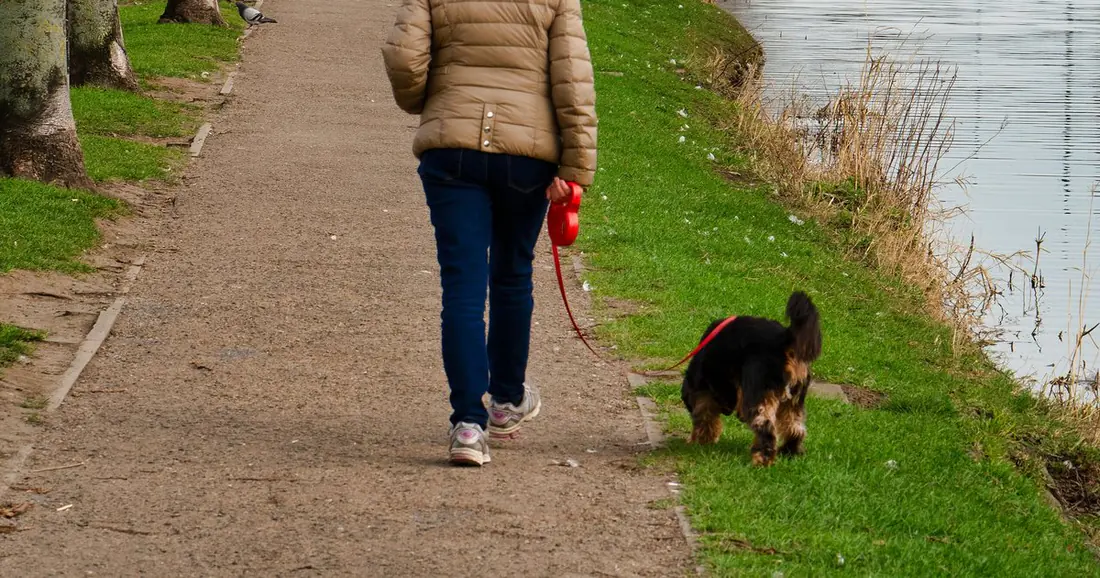
Why Does My Dog Follow Me Everywhere? Velcro or Anxiety
By Dog Translator · · 6 min read
Your dog follows you to the kitchen, the couch, the bathroom and back. In most cases this is normal. Dogs are social animals that bond strongly to their people, you are the source of food, walks and everything interesting, and some breeds were bred for generations to keep their eyes on a human. What matters is whether the following is a preference or a panic. That one distinction decides whether you do nothing or do something.
The short answer: five reasons
| Reason | What it looks like | Problem? |
|---|---|---|
| Attachment | Follows, settles near you, relaxed | No |
| You are where the good stuff is | Follows more around meals, walks, treats | No |
| Breed | Herding and working dogs track you constantly | No |
| Habit you built | Rewarded for being close, never practiced being apart | Mild |
| Separation anxiety | Distress when it cannot reach you | Yes |
Attachment
Dogs form genuine attachment bonds with their owners. In a 1998 study, researchers adapted the Strange Situation Test used with human infants and found that dogs explored more with their owner present, searched for the owner when left with a stranger, and greeted them on return. Staying near an attachment figure is what that bond looks like day to day. It is one of the reasons following shows up on lists of signs your dog loves you, although on its own it is weak evidence.
You control the resources
AKC points out the obvious: you open the fridge, you hold the leash, you know where the treats live. Dogs that follow most around meal times and in the evening are tracking the schedule, not just you.
Breed
AKC notes that herding and working breeds are especially prone to following. An Australian Shepherd, a Border Collie or a Corgi was bred to watch a handler and respond to small signals. Retrievers like the Labrador and Golden Retriever were bred to work alongside people too. A dog that tails you was selected for it.
You built the habit
Puppies that are always with someone, sleep in the bed and never get practice being alone often become shadows as adults. That is not a disaster, but it leaves the dog unprepared for the day you have to leave it.
Velcro dog or separation anxiety? The checklist
AKC draws the line clearly: a velcro dog prefers to be close, while a dog with separation anxiety panics when it is apart from its owner. Go through these honestly.
| Question | Velcro dog | Separation anxiety |
|---|---|---|
| You close the bathroom door. What happens? | Waits outside, maybe lies down | Scratches, whines, barks without stopping |
| You leave the house for 20 minutes | Settles or sleeps after a minute or two | Howls, barks, paces the whole time |
| Signs of damage when you return | None | Chewed doorframes, scratched doors, torn blinds |
| House-trained dog, accidents only when alone | No | Yes |
| Will it eat a food puzzle while you are gone? | Yes | Often ignores food until you return |
| Greeting when you come back | Happy, calms down soon | Frantic, takes a long time to settle |
If most of your answers fall in the right column, film the dog when you leave. Separation anxiety is a recognized behavior problem. The ASPCA and VCA list destruction aimed at exits, house soiling only when alone, howling and barking, pacing and escape attempts among its signs. Mild cases can improve with gradual training. Severe ones usually need a veterinary behaviorist, sometimes with medication, and that is nothing to be embarrassed about.
If it is just velcro: what to change
You do not have to stop a dog from liking you. The goal is a dog that is comfortable either way. AKC's trainers suggest the same short list that works in practice:
- More exercise and more mental work. A dog that has walked, sniffed and solved a puzzle is more likely to nap than to shadow you.
- Teach a 'place' or 'stay' cue. Start with one second on a mat while you take one step away. Build to minutes and to you leaving the room.
- Practice short absences. Step out of the room for 10 seconds, come back calmly. Then 30. Then a minute. Keep them boring.
- Make departures and arrivals low-key. Big goodbyes and big hellos make the transition feel like an event.
- Give the dog a good spot of its own: a bed in a quiet corner with a long-lasting chew that it only gets there.
If it is anxiety: what treatment looks like
Separation anxiety improves with gradual exposure, done below the point where the dog panics. That usually means much shorter absences than owners expect.
- Find the threshold. Film yourself leaving. If the dog starts to panic at 30 seconds, your training absences start at 10.
- Practice departures that go nowhere. Pick up keys, put on shoes, sit back down. These cues stop predicting that you are leaving.
- Step out for a few seconds, come back before the dog gets upset. Repeat several times a day.
- Increase the time slowly. If the dog panics, go back to the last duration that worked.
- Avoid real absences that exceed the threshold while you train, which may mean a dog sitter or daycare for a while.
Things that make it worse: crating a dog that panics in the crate, punishing damage you find when you come home, and leaving the dog for full workdays while you train. A veterinary behaviorist can add medication when needed, which often makes the training work faster.
When it changes suddenly
A dog that was independent and suddenly will not leave your side is telling you something changed. Common reasons: a move, a new baby or pet, a loss in the household, or the dog not feeling well. Older dogs with failing sight, hearing or cognition often become clingier because you are their anchor. If a sudden change comes with other signs like restlessness at night, a new whining habit or changes in appetite, see a vet.
Should a velcro dog sleep in your bed?
For a dog without separation anxiety, it is your call. Sleeping together does not cause clinginess on its own, and plenty of dogs share a bed and are perfectly independent during the day. For a dog that panics when alone, it is worth giving it a bed of its own next to yours, so it practices sleeping a short distance away while you are still in the room. That small gap is a building block for the longer gaps later.
Why the bathroom?
It is the one room you close the door on, which makes it interesting, and you disappear behind it. A dog that waits calmly outside is fine. A dog that scratches and cries at the door is giving you the clearest separation test you will get, every single day. For more on reading what your dog is telling you through posture, read the dog body language guide.
Frequently asked questions
Is it bad if my dog follows me everywhere?
Usually not. Most dogs follow their owners out of attachment, routine or breed instinct. It is a problem only when the dog panics when it cannot reach you, which points to separation anxiety.
What is a velcro dog?
A velcro dog is one that prefers to stay close to its owner. Unlike a dog with separation anxiety, it can settle when apart. Herding and working breeds are common velcro dogs.
Why does my dog follow me to the bathroom?
You disappear behind a closed door, which is interesting and slightly worrying to a bonded dog. Waiting calmly outside is normal. Frantic scratching or crying is a sign to look into separation anxiety.
Why is my dog suddenly following me everywhere?
A sudden change usually has a cause: a move, a new person or pet, a loss in the household, illness, or age-related changes in sight, hearing or cognition. If other signs appear, see a vet.