Why Do Dogs Growl? 5 Growls and How to Tell Them Apart
By Dog Translator · · 6 min read
A growl is the most useful sound your dog makes. It is a warning that comes before teeth, and it is how a dog says 'I am not comfortable' without hurting anyone. It is also how dogs say 'this is fun' during tug of war. Same sound family, opposite meanings. The trick is telling them apart, and research shows dogs themselves are very good at it.
Dogs can tell growls apart. So can you.
In 2010, researchers in Budapest recorded growls from 20 dogs in three situations: guarding a bone from another dog, playing tug with a person, and being approached in a threatening way by a stranger. They then played the growls back to other dogs that were approaching a bone. Dogs that heard the food-guarding growl backed away from the bone. Dogs that heard the play growl or the stranger growl mostly ignored it, because those growls did not concern the bone. The growls carried specific information, not just 'angry'.
A separate study the year before, in Ethology, found that growl acoustics vary with context in measurable ways. Play growls tend to be shorter and come in bursts. You do not need a spectrogram to use this. You need to listen and look at the whole dog.
| Growl | Sound | Body | Meaning |
|---|---|---|---|
| Play | Short bursts, mid to high pitch, often noisy and theatrical | Loose, bouncy, play bows, mouth open | Fun |
| Guarding | Low, steady, starts when you approach the item | Stiff, head low over the item, freezing | Back off from my thing |
| Fear | Low, often mixed with barks or whines | Weight back, tail low or tucked, whale eye | Go away, I am scared |
| Pain | Sudden, when touched or moved | Guarding a body part, flinching | That hurts |
| Contentment rumble | Soft, low grumble during petting | Fully relaxed, eyes half closed, leaning in | Keep going |
1. The play growl
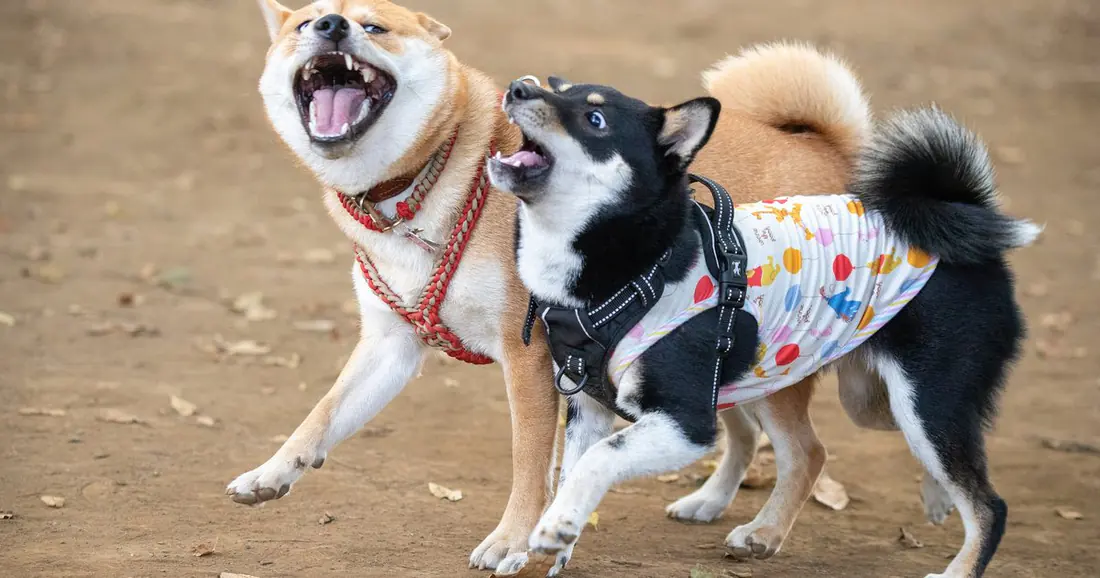
Play growls can sound alarming because some dogs are loud, dramatic players. Look for the play markers: a play bow, bouncy movement, open relaxed mouth, role reversals where the dogs take turns chasing and being chased, and frequent pauses. Many dogs huff or sneeze during play to keep it friendly, which we explain in why dogs huff. Play that becomes one-sided, with one dog trying to escape, needs a break.
2. The guarding growl
This is the growl over a bone, a toy, a bed or a person. The dog often freezes, lowers its head over the item and watches you out of the corner of its eye. Do not grab the item. That proves to the dog that guarding was necessary. Instead, trade up: walk by, drop something better, and walk away. Over time the dog learns that your approach brings good things. If guarding is intense, get a professional involved before you work on it.
3. The fear growl
A fearful dog growls to create distance. Its weight shifts backward, the tail drops, ears go back, and you may see the whites of its eyes. The right response is to give it the distance it is asking for. Then work out the trigger, whether it is a stranger leaning over, a child hugging, or the vet table, and change the situation so the dog does not need to growl.
4. The pain growl
A dog that growls when you touch a specific spot, help it up or lift it is telling you it hurts. VCA lists uncharacteristic growling and aggression when touched among the signs of pain, even in normally gentle dogs. A growl that is new in an older dog is a medical question first. Our guide on dogs groaning when you pet them covers how to tell a contented noise from a sore one.
5. The contentment rumble
Some dogs grumble when they are happy. AKC describes a low rumble or loud purr that signals contentment. Rottweilers are famous for it: the 'Rottie rumble' during a belly rub sounds menacing to strangers and means the opposite. The Rottweiler sounds page covers it. The body tells you which is which: a rumbling dog that is melting into your hand is happy.
Growling when woken or moved
A lot of household growls happen on the couch or the bed. The dog is asleep, someone sits down or tries to move it, and it growls. Startled dogs react before they are fully awake, and older dogs with sore joints are less happy about being shifted. Call the dog off the furniture with a treat instead of pushing it, and wake sleeping dogs by saying their name from a distance. If it guards the spot even when awake, treat it like any other guarding: trade, do not grab.
Growling at other dogs
Growls between dogs are normal social communication. A short growl that makes another dog back off, followed by both dogs moving on, is the system working. Step in when one dog keeps pushing after being warned, when growls come with stiff, frozen standoffs, or when the same pair keeps having tense moments around food, toys or doorways. Feed separately, pick up high-value items when both dogs are loose, and give each dog an escape route.
Growling at children
Take every growl at a child seriously, even if the child was doing something the dog normally tolerates. Children hug, lean over and grab, which are the exact things many dogs find threatening. The rule that prevents most bites is simple: supervise actively or separate. Teach children to let the dog come to them, to pet the side of the body rather than the head, and to leave a sleeping or eating dog alone. If the growling repeats, talk to a professional before something worse happens.
Never punish a growl
This is the most important point in the guide, and AKC is blunt about it. Punishing a growl stops the sound and leaves the feeling. The dog is still uncomfortable around the stranger, the toddler or the food bowl. It has only learned that warning you is a bad idea. The next time it is pushed past its limit, it skips the warning and bites. A dog that bites without growling is much more dangerous than one that growls.
Why does my dog growl at me?
If your own dog growls at you, it is almost always one of these: you approached something it values, you touched a sore spot, you woke it suddenly, or you did something that scared it, like reaching over its head. Write down when it happens. The pattern usually shows up within a week. Guard-bred and protective breeds like the German Shepherd and Doberman may growl more readily at visitors, and small dogs like the Chihuahua often growl because people handle them without asking. Neither is a character flaw. It is a dog communicating clearly.
Growling that is frequent, escalating or aimed at family members is worth a visit to a veterinary behaviorist or a certified trainer who uses reward-based methods. For the rest of your dog's vocabulary, read the dog to human translator guide.
Frequently asked questions
How can I tell a play growl from an aggressive growl?
Look at the body. Play growls come with loose, bouncy movement, play bows and turn-taking. Aggressive or fearful growls come with stiffness, freezing, a lowered head or weight shifted back.
Should I punish my dog for growling?
No. Punishment removes the warning but not the discomfort behind it, which makes a bite without warning more likely. Give the dog space and address the cause.
Why does my dog growl when I pet him?
Either it is a contented rumble (body relaxed, leaning in) or it is discomfort or pain (body stiff, flinching, a specific spot). New growling when touched is worth a vet check.
Do dogs understand other dogs' growls?
Yes. In a 2010 playback study, dogs backed away from a bone when they heard a recorded food-guarding growl but mostly ignored play growls and growls aimed at strangers.
Sources
- Faragó T. et al. (2010). 'The bone is mine': affective and referential aspects of dog growls. Animal Behaviour 79, 917-925.
- Taylor A.M., Reby D., McComb K. (2009). Context-related variation in the vocal growling behaviour of the domestic dog. Ethology 115, 905-915.
- American Kennel Club: Why Dogs Growl, Meaning, Types, and How to Respond
- American Kennel Club: Canine Communication, Deciphering Different Dog Sounds
- VCA Animal Hospitals: How Do I Know if My Dog Is in Pain?