Signs Your Dog Loves You, Ranked by the Evidence
By Dog Translator · · 6 min read
Your dog cannot tell you it loves you, so every list of signs is an inference. The useful question is which inferences hold up. Researchers have measured hormones during eye contact, scanned dog brains while they smelled their owners, filmed tail wags frame by frame and run attachment tests designed for human babies. Some popular signs survive that scrutiny. Others are guesses. One is a myth.
| Sign | What was measured | Evidence |
|---|---|---|
| Long, soft eye contact | Oxytocin rose in owners after mutual gazing (Nagasawa et al., 2015) | Strong |
| Your scent lights up its brain | Reward area responded most to a familiar human's scent (Berns et al., 2015) | Strong |
| Uses you as a safe base | Attachment test adapted from infant research (Topál et al., 1998) | Strong |
| Tail wags more to the right when greeting you | Wag direction filmed for familiar vs unfamiliar stimuli (Quaranta et al., 2007) | Moderate |
| Puppy-dog eyebrows at you | A muscle wolves lack; dogs use it more with people (Kaminski et al., 2019) | Moderate |
| Follows you room to room | Observed widely; also explained by habit and food | Weak on its own |
| Leans on you, sleeps against you | Common, rarely studied directly | Weak |
| Licks your face | Has several explanations besides affection | Weak |
| Looks 'guilty' when you get home | Driven by your scolding, not the dog's guilt (Horowitz, 2009) | Myth |
Strong evidence
Eye contact
This is the best-supported sign there is. In a 2015 study in Science, Japanese researchers measured oxytocin, a hormone tied to bonding, in dogs and their owners. Pairs that shared longer mutual gazes showed bigger oxytocin increases, in the owners and in the dogs. Hand-raised wolves did not show the effect with their handlers. In a second experiment, female dogs given oxytocin spent more time gazing at their owners, which in turn raised the owners' levels. The authors called it a positive loop.
The difference between a loving gaze and a hard stare is in the face. A relaxed dog blinks, its eyes are soft and its mouth is loose. A hard, fixed stare with a stiff body is a warning, and the dog body language guide covers how to tell them apart.
Your smell
Gregory Berns and colleagues at Emory trained 12 dogs to lie still in an MRI scanner and presented them with five scents: their own, a familiar dog, an unfamiliar dog, a familiar human and an unfamiliar human. The caudate nucleus, a region associated with reward and anticipation, responded most strongly to the scent of the familiar human. Not to food, not to the dog next door. To you.
This is why dogs steal your socks and sleep on your side of the bed. They are not being weird. Your smell is rewarding to them in a measurable way.
Using you as a safe base
In 1998, Hungarian researchers adapted the Strange Situation Test, a classic method for measuring how human infants attach to their parents, to dogs. Dogs explored and played more when their owner was in the room, searched for the owner when left with a stranger, and greeted the owner when they came back. The behavior looked a lot like the infant pattern. In daily life, a dog that checks in with you at the park, comes back to you when something startles it and relaxes once you show up is showing exactly that.
Moderate evidence
Which way the tail wags
A 2007 study in Current Biology filmed 30 dogs reacting to four stimuli. When they saw their owner, the wag was biased to the right side of the body. When they saw an unfamiliar dominant dog, it shifted to the left. The explanation is brain lateralization: each half of the brain controls the opposite side of the body, and the left hemisphere is linked to approach. It is a real effect, but too subtle to spot reliably at home without slow-motion video.
Puppy-dog eyes
Dogs have a facial muscle that raises the inner eyebrow, making the eyes look bigger and sadder. A 2019 study in PNAS found that wolves largely lack it and that dogs make the movement far more often. An earlier study found shelter dogs that raised their eyebrows more were rehomed faster. That makes it a strong signal aimed at people. Whether it means love or 'please share that sandwich' depends on the moment.
Weak evidence: real, but not proof
Following you around, leaning on you, sleeping against you and licking your face all happen in dogs that are bonded to their people. They also happen for other reasons. Dogs follow the person who controls the food. They lean on people when they are anxious. They lick faces because puppies lick their mother's mouth to ask for food, and because skin is salty. None of these is a bad sign. They just are not specific enough to count as evidence by themselves. If your dog shadows you all day, our guide on why dogs follow you everywhere explains when it is affection and when it is anxiety.
The myth: the guilty look
Owners love this one. You come home, the trash is on the floor, and your dog slinks over with its head low and its eyes averted. Surely that means it knows it did wrong. Alexandra Horowitz tested this in 2009. Owners were told whether their dog had eaten a forbidden treat, but some were told wrong. The guilty look appeared most when owners scolded the dog, whether or not the dog had actually disobeyed. Dogs that had behaved and got scolded looked the guiltiest of all.
The 'guilty' face is appeasement: lowered body, averted eyes, lip licking. It is the dog responding to your anger in the moment. It is not remorse and it is not a sign of love, and punishing the dog for it teaches only that your arrival is scary.
How to build more of the strong signs
The strong signs are not fixed traits. They grow with the kind of time you spend together. A few things reliably help:
- •Short daily training sessions with rewards. Training is shared attention, and dogs that train with their owners look at them more.
- •Play that you start and you join, not just a ball thrown while you look at your phone.
- •Sniff walks where the dog sets the pace for part of the route.
- •Predictable routines. A dog that knows what happens next relaxes around you, and a relaxed dog shows affection more openly.
- •Never using fear. A dog that is scared of your reaction cannot use you as a safe base, which is the point of the bond in the first place.
What to do with this
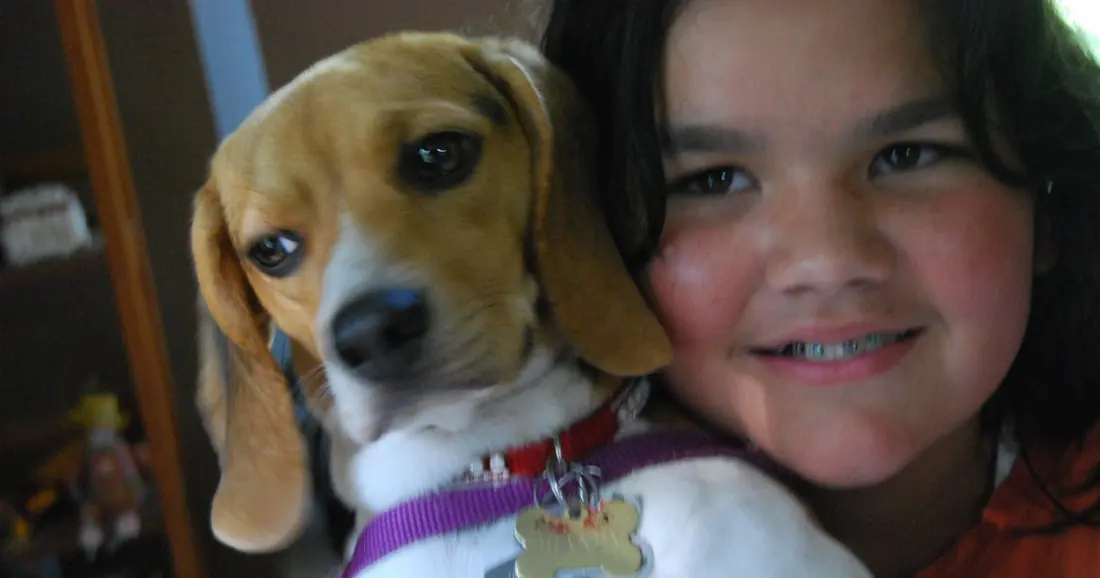
If your dog gazes at you softly, seeks you out when it is unsure and greets you like you have been gone a year, you have the strongest signs science has found. The rest is detail. Breeds bred to work closely with people, like the Labrador and Golden Retriever, tend to be more openly affectionate. A Beagle might express the same bond with more nose and less eye contact. Learn your own dog's version, and if you want to talk back, start with how to talk to your dog.
Frequently asked questions
How can I tell if my dog loves me?
The best-supported signs are soft mutual eye contact, using you as a safe base when unsure, an enthusiastic greeting when you return and a strong attraction to your scent. Each of these has been measured in published studies.
Does my dog know I love it?
Dogs respond to the same bonding signals people use. Mutual gazing raised oxytocin in both dogs and owners in a 2015 study, which suggests the bond works in both directions.
Do dogs feel guilty when they do something wrong?
The research says no. A 2009 study found the guilty look was driven by the owner scolding the dog, not by whether the dog had actually misbehaved. It is appeasement, not remorse.
Is licking a sign of affection?
Sometimes, but not reliably. Dogs also lick faces as a leftover puppy food-begging behavior, to appease, or because skin tastes salty. It is a weak sign on its own.
Sources
- Nagasawa M. et al. (2015). Oxytocin-gaze positive loop and the coevolution of human-dog bonds. Science 348, 333-336.
- Berns G.S., Brooks A.M., Spivak M. (2015). Scent of the familiar: an fMRI study of canine brain responses to familiar and unfamiliar human and dog odors. Behavioural Processes 110, 37-46.
- Topál J. et al. (1998). Attachment behavior in dogs: a new application of Ainsworth's Strange Situation Test. Journal of Comparative Psychology 112, 219-229.
- Quaranta A., Siniscalchi M., Vallortigara G. (2007). Asymmetric tail-wagging responses by dogs to different emotive stimuli. Current Biology 17, R199-R201.
- Kaminski J. et al. (2019). Evolution of facial muscle anatomy in dogs. PNAS 116, 14677-14681.
- Waller B.M. et al. (2013). Paedomorphic facial expressions give dogs a selective advantage. PLOS ONE 8, e82686.
- Horowitz A. (2009). Disambiguating the 'guilty look': salient prompts to a familiar dog behaviour. Behavioural Processes 81, 447-452.