Why Do Dogs Roll in Grass? 5 Theories, Ranked
By Dog Translator · · 6 min read
Dogs roll in grass for several reasons, and the honest answer is that nobody knows which one is behind any given roll. Some are well supported: scratching a spot it cannot reach, cooling off, and play. One is famous but only partly understood: rolling to pick up or spread a smell. The ranking below separates what has been studied from what is educated guessing.
The theories, ranked
| Theory | What supports it | Our confidence |
|---|---|---|
| Scratching an itch | Simple mechanics: paws cannot reach the back | High |
| Play and joy | Rolling over is a documented play move between dogs | High |
| Cooling off | The belly has less fur; cool grass helps | Moderate |
| Picking up a smell | Wolves scent-rub on strong, novel odors | Moderate |
| Leaving its own smell | Proposed, but the body parts used do not fit well | Low |
1. An itch it cannot reach
AKC gives the simplest explanation first: a dog's paws cannot reach its back, so rolling on grass or carpet is how it scratches. Grass is textured, slightly springy and often cool. If your dog rolls after a bath, a haircut or a new collar, the itch theory is probably right. If it rolls all the time, look at the skin. AKC warns that frequent rolling with itching can point to fleas or skin irritation, and that unchecked scratching can lead to painful hot spots.
2. Play
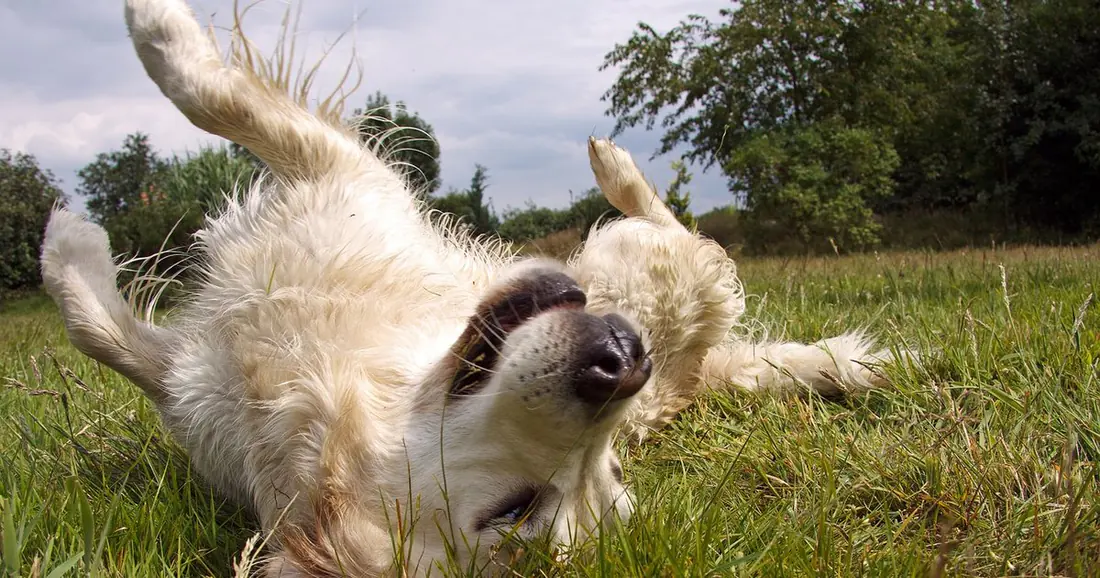
Rolling onto the back is a real play move. AKC describes a back roll as an invitation to roughhouse, especially with smaller dogs or puppies. A 2015 study in Behavioural Processes looked at dogs rolling over during play and found the rollers used the position to launch their own play attacks or to dodge play bites to the neck. It was a tactic, not surrender. The same loose, wiggly roll on the lawn after a walk, with the mouth open and legs flailing, is a dog having fun. Often there is a play huff or sneeze in there too.
3. Cooling off
AKC notes that dogs mostly cool down by panting and sweat only through their paw pads, and that exposing the less furry belly to cool grass or a breeze can help on a hot day. If your dog flops and rolls in the shade on a summer walk, this is a good bet. Be alert to overheating, especially in flat-faced breeds.
4. Wearing a smell
This is the one owners dread: the dog finds something foul, drops a shoulder and grinds itself into it. Researchers have studied the same behavior in wolves. In a 1986 study in the Canadian Journal of Zoology, captive wolves were offered eight new smells. Manufactured odors, perfume and motor oil, got the strongest rubbing response. Feces from carnivores like cougars and bears came second. Food smells barely registered, and feces from plant-eating animals were not rubbed at all. So it is not simply 'roll in anything that stinks'. Wolves picked strong, unusual smells.
Why they do it is still debated. AKC summarizes the main ideas: masking their own scent while hunting, carrying the smell back to show other dogs what they found, or simply liking the smell. Your dog rolling in fresh-cut grass, fox scent or something dead in the lawn fits the same pattern. A dog that ignores the grass everywhere else and keeps going back to one spot has found a smell.
5. Leaving its own smell
One theory says dogs roll to mark a spot with their own scent. AKC quotes a vet who is skeptical, because dogs rub with their backs and shoulders rather than the cheeks and neck that would leave saliva. It may play a small role, but it is the weakest of the five.
Rolling when it is not about grass
Rolling on the back has social meanings too. AKC describes dogs rolling over to show they mean no harm, often at greetings or when someone raises their voice, and anxious dogs rolling over to defuse tension. The difference is in the body. A happy roller is loose and wiggly with an open mouth. A worried one is stiff or trembling, looks away, has its ears pinned and may urinate. That second dog is asking for space, not a belly rub.
The post-bath roll
Many dogs come out of the bath and immediately roll on the carpet, the grass or the nearest towel. The coat is wet and itchy, the shampoo smells strange, and rolling dries and scratches at the same time. Some people think the dog is trying to get its own smell back after you washed it off. That is plausible but untested. Either way, keep a towel handy and let the dog do its post-bath zoomies somewhere you do not mind.
Cleaning up after a smelly roll
- Keep the dog outside or in a bathroom until you can wash it, so the smell does not end up on furniture.
- Use dog shampoo and rinse thoroughly. A second wash usually does more than a stronger product.
- Check around the collar and ears, where the worst of it tends to collect.
- Wash the collar or harness separately. It holds the smell long after the dog is clean.
Rolling and the zoomies
Rolling often comes in a sequence with other happy, loose behaviors: a sniff, a drop, a wriggle on the back, a jump up, a full-body shake and then a sprint around the yard. That burst of energy is commonly called the zoomies, and it is normal, especially in young dogs, after baths and at the end of a walk. Make sure the area is safe from slippery floors and sharp corners, and let it run its course.
Why some dogs never roll
Not every dog rolls in grass, and that is not a problem. Some dogs dislike wet grass, some have sensitive skin, and some simply prefer the couch. Older dogs with stiff backs may stop rolling because it is uncomfortable. If a dog that always rolled happily stops completely and also seems stiff getting up, that change is worth mentioning to your vet.
When to stop it
- •Treated lawns: pesticides and fertilizers can irritate skin or be swallowed during grooming. Steer clear of freshly treated grass.
- •Dead animals and feces: a reliable recall and a pocket of good treats are the best tools, according to AKC. Call the dog away before it drops its shoulder.
- •Constant rolling with scratching: check for fleas and skin problems, and see your vet.
- •Rolling with stiffness, pinned ears or trembling: the dog is stressed. Remove the pressure.
Otherwise, let it roll. It costs you nothing, it is one of the clearest signs of a relaxed dog, and trying to stop every roll mostly teaches the dog to ignore you. A Golden Retriever or Labrador rolling on a summer lawn is about as content as dogs get. Scent hounds like the Beagle are more likely to go for the smelly version. If the roll ends with a big full-body shake, that is the dog resetting, which we explain in why dogs shake.
Frequently asked questions
Why does my dog roll in the grass after a walk?
Usually to scratch an itch, to cool down, or simply because it feels good. A loose, wiggly roll with an open mouth is play and contentment.
Why do dogs roll in smelly things?
Nobody knows for sure. Wolves scent-rub on strong, unusual odors, and the leading ideas are masking their own scent, bringing the smell back to show other dogs, or simply liking it.
Is it bad if my dog rolls in grass?
Generally no. Avoid freshly treated lawns, call the dog away from dead animals and feces, and check for fleas or skin problems if it rolls and scratches constantly.
Does a dog rolling on its back mean it is submissive?
Not necessarily. Research on play found dogs roll over to launch play attacks or dodge bites. Rolling can also mean a belly-rub request, appeasement or, in a stiff and trembling dog, fear.
Sources
- American Kennel Club: Why Does My Dog Roll on Their Back?
- American Kennel Club: Why Does My Dog Roll Around Where Something Has Died?
- Ryon J., Fentress J.C., Harrington F.H. et al. (1986). Scent rubbing in wolves (Canis lupus): the effect of novelty. Canadian Journal of Zoology 64, 573-577.
- Norman K. et al. (2015). Down but not out: supine postures as facilitators of play in domestic dogs. Behavioural Processes 110, 88-95.