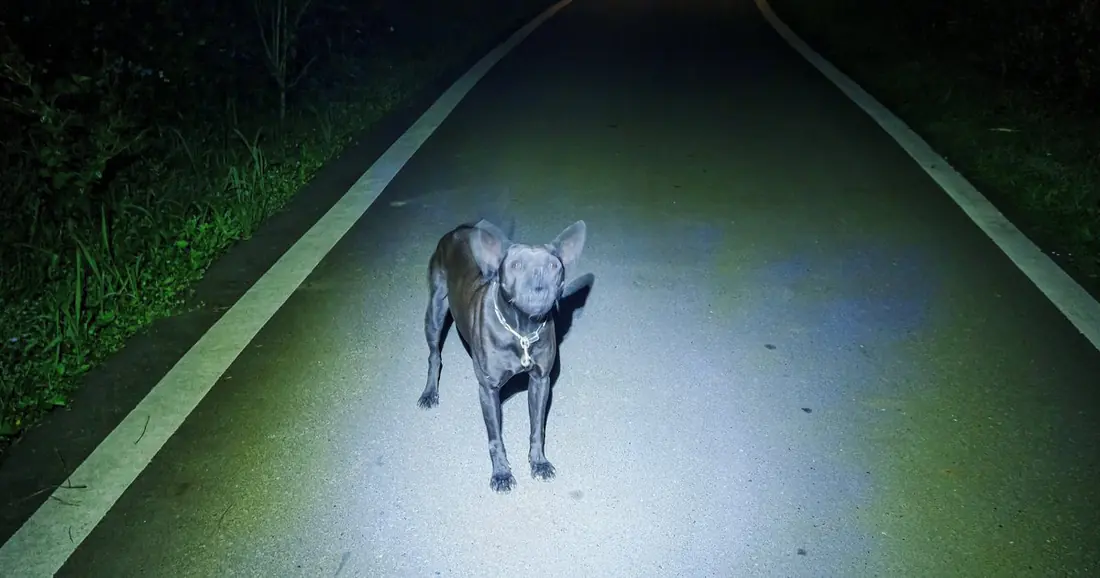
Why Do Dogs Bark at Night? Diagnose It in 3 Steps
By Dog Translator · · 6 min read
Dogs bark at night for the same reasons they bark during the day. The difference is that at night the house is quiet, you are trying to sleep, and the dog is reacting to things you cannot see or hear. Dogs hear higher frequencies and fainter sounds than people do, so 'barking at nothing' is almost always barking at something. The job is to figure out what, and that takes three steps.
Step 1: Listen to the bark
Barks are not random. In a 2004 study, Sophia Yin and Brenda McCowan recorded barks from 10 dogs in three situations: a stranger at the door, being left alone, and play. The barks differed by context. Disturbance barks were harsher, lower and came in long strings. Isolation barks were higher pitched, more tonal and spaced out. People can hear the difference too: in a 2005 study, listeners sorted recorded barks into the right situation well above chance, even if they did not own a dog.
| What you hear | Likely context | Leans toward |
|---|---|---|
| Rapid, deep, harsh barks in a long string | Disturbance | Wildlife, a noise outside, another dog |
| Single high barks with long pauses | Isolation | Loneliness, wanting to be let in |
| Barks at you, then waiting | Demand | Learned attention or a real need |
| Barks mixed with whines and pacing | Distress | Anxiety, pain, confusion |
| Barking that starts when another dog barks | Social | Joining the neighborhood chorus |
Record a night of it. A phone left near the dog's bed is enough, and most voice recorders show you a timeline so you can skip to the noisy parts.
Step 2: Check the pattern
The timing narrows things down fast.
| Pattern | Most likely cause |
|---|---|
| Same time every night, at a window or door | Wildlife, a neighbor's routine, a cat on the fence |
| Right after you go to bed | Separation from you or wanting to be let in |
| In the middle of the night, then wants out | Needs a potty break |
| Started recently in a dog over 8 or so | Pain or cognitive decline |
| After a low-activity day | Pent-up energy, boredom |
| When other dogs in the neighborhood bark | Socially triggered barking |
Step 3: Fix the cause you found
Something outside
This is the most common cause and the easiest to fix. Raccoons, foxes, cats and late-night foot traffic are all real to your dog. Block the view: close the blinds, move the dog's bed away from the front of the house or put frosted film on low windows. A fan or white noise machine masks the faint sounds that start the chain. Breeds bred to guard, like the German Shepherd, or to alert, like many terriers including the Yorkshire Terrier, will be more sensitive to this.
Loneliness and separation
Dogs are social. A dog moved out of the bedroom, or left in a yard at night, often barks because it is alone. The simplest fix is letting the dog sleep closer to you, even in a crate in your room. If that is not an option, make the transition gradual and make the sleeping spot good: a solid bed, a chew, and a worn T-shirt that smells like you.
Boredom
A dog that spent the day on the couch is ready to go at 2 a.m. Add a real walk in the evening, ten minutes of sniffing or training before bed, or a food puzzle. Mental work tires dogs out faster than people expect. A Beagle that gets to use its nose on a long evening sniff walk sleeps better than one that got a fast lap of the block.
Demand barking
If the dog barks at your bedroom door and you get up, you have taught it that barking opens doors. The ASPCA's advice is to stop rewarding the barking completely, then reward quiet. First rule out a real need: give a last potty break right before bed. After that, do not respond to barking. Respond to silence.
The neighborhood chorus
The ASPCA calls it socially facilitated barking: one dog starts and every dog within earshot joins in. If your dog's night barking always starts a few seconds after a dog down the street, that is your answer. White noise and a sleeping spot on the quiet side of the house help most. Training a 'quiet' cue during the day, when the chorus is weaker, gives you something to use at night.
The senior dog
Pay attention here. A dog that never barked at night and starts doing it in old age may have pain or canine cognitive dysfunction, a condition similar to dementia. VCA lists night-time restlessness, disrupted sleep and excessive vocalization, including barking at nothing, among its signs. AKC describes the same pattern. It is diagnosed by a vet, and there are treatments and management strategies. Do not treat it as a training problem.
A one-week plan
If you found the cause, fix that. If you are still not sure, this sequence covers the most common causes in order and costs nothing.
- Night 1: record the night. Note the times and what the barks sound like.
- Night 2: last potty break right before bed, and no water in the hour before unless your vet says otherwise.
- Night 3: add 20 minutes of sniffing or training in the evening.
- Night 4: block the view from the dog's sleeping spot and add white noise.
- Night 5: move the dog's bed closer to you if separation is a possibility.
- Nights 6 and 7: stop responding to demand barking completely, and reward quiet in the morning with breakfast and attention.
Change one thing per night so you can see what worked. If nothing changed after a week, or the dog is a senior, it is time for the vet.
What does not work
- •Anti-bark collars. The ASPCA calls them punishment devices and not a first choice, and notes that most dogs become 'collar-wise': quiet with the collar on, barking again without it. They also do nothing for a dog barking from pain or confusion.
- •Yelling. To a barking dog, you are barking too.
- •Leaving the dog outside to 'tire itself out'. Outdoor dogs at night hear and see more, so they usually bark more.
- •Ultrasonic deterrents aimed at your own dog. They startle without teaching anything, and they cannot tell a raccoon bark from a pain bark.
When to call someone
See a vet if the night barking is new, the dog is a senior, or it comes with restlessness, pacing, accidents or confusion during the day. See a certified trainer or veterinary behaviorist if it is tied to being alone and is getting worse. Small, alert breeds like the Chihuahua can be persistent night barkers, and a professional can save you weeks of trial and error. For what different barks mean in general, read the dog bark translator guide.
Frequently asked questions
Why does my dog bark at night at nothing?
Dogs hear fainter and higher-pitched sounds than people, so barking at nothing is usually barking at wildlife, a distant dog or a noise you missed. In senior dogs, new night barking can also be a sign of pain or cognitive dysfunction.
Should I ignore my dog barking at night?
Ignore demand barking after you have ruled out a real need like a potty break. Do not ignore new night barking in a senior dog, or barking that comes with pacing and distress.
Do anti-bark collars stop night barking?
The ASPCA does not recommend them as a first choice. Most dogs learn to stay quiet only while wearing the collar, and the collar does nothing about the cause.
Why did my old dog start barking at night?
Pain and canine cognitive dysfunction are the two most common reasons. VCA lists night-time restlessness and barking at nothing among the signs of cognitive dysfunction. A vet visit is the right first step.
Sources
- Yin S., McCowan B. (2004). Barking in domestic dogs: context specificity and individual identification. Animal Behaviour 68, 343-355.
- Pongrácz P. et al. (2005). Human listeners are able to classify dog barks recorded in different situations. Journal of Comparative Psychology 119, 136-144.
- Molnár C. et al. (2008). Classification of dog barks: a machine learning approach. Animal Cognition 11, 389-400.
- ASPCA: Barking
- VCA Animal Hospitals: Behavior Counseling, Senior Pet Cognitive Dysfunction
- American Kennel Club: Dementia in Dogs