Why Do Dogs Like Belly Rubs? And When They Don't
By Dog Translator · · 6 min read
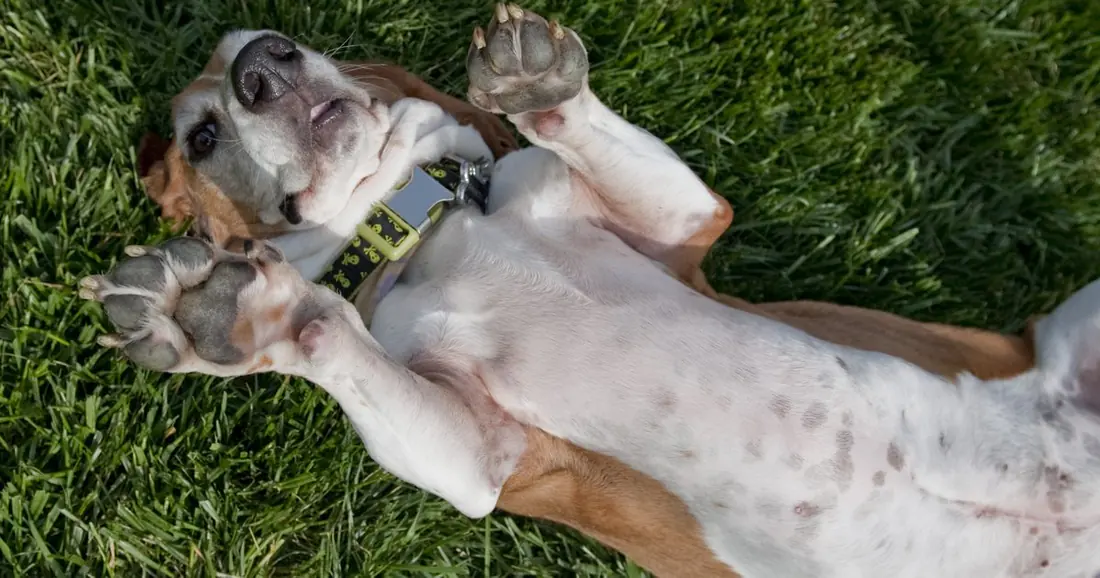
Many dogs like belly rubs because petting feels good and the belly is a soft, thin-furred spot where touch comes through clearly. AKC is honest that there has been no scientific research on belly rubs specifically. There is research on petting, though, and it shows touch matters a lot to dogs. The catch is that rolling onto the back has several meanings, and only one of them is 'please rub my belly'.
Is it an invitation? Read the dog
| Signal | Wants a belly rub | Does not |
|---|---|---|
| Mouth | Open, tongue lolling | Closed, maybe just the tongue tip showing |
| Eyes | Open, relaxed, looking at you | Looking away, whites showing |
| Body | Loose, wiggly, legs floppy | Stiff, tense or trembling |
| Tail | Relaxed or wagging loosely | Tucked between the legs |
| When you start | Melts, closes eyes, leans in | Freezes, moves away, licks lips |
| When you stop | Paws at you, wiggles for more | Rolls back over and leaves |
What research says about petting
Psychologists Erica Feuerbacher and Clive Wynne ran a series of choice experiments in which dogs could spend time with a person who petted them or a person who praised them. In their 2015 study in Behavioural Processes, shelter dogs and owned dogs, with strangers and with owners, all preferred petting to vocal praise. Praise produced as little attention-seeking as no interaction at all, and dogs showed no sign of getting tired of petting over eight sessions.
Food is a strong competitor. In a 2014 study by the same team, dogs given a choice between food and petting generally chose food when it was readily available, and shifted toward petting as food became scarcer. So petting is valuable, but it is not magic. For most dogs, a belly rub is a pleasant form of social contact, not a cure for everything.
Why the belly specifically
Dr. Stanley Coren, quoted by AKC, puts it simply: for some dogs a belly rub is just a variant of being petted, and the fur on the belly is less dense and softer, so the touch is less muted. The belly is also hard for a dog to scratch itself, which may make a good rub there feel even better.
Other reasons dogs roll over
- •To play. Rolling over is a play move. A study on dog play found rollers used the position to launch play attacks or dodge play bites, not to surrender. More in why dogs roll in grass.
- •To cool off. Coren notes dogs expose the thin-furred belly on hot days.
- •To appease. Dogs roll onto their backs when someone raises their voice or when they feel threatened, to show they mean no harm.
- •Out of fear. A frightened dog may roll over, avoid eye contact, tuck the tail and stay stiff. That dog wants space, not touch.
- •To scratch. Rolling on carpet or grass reaches an itch paws cannot.
Not every dog likes belly rubs
Coren calls it a myth that all dogs love belly rubs. Some dogs who enjoy other petting do not want their bellies touched, and he suggests some guarding breeds may see a reach toward the belly as a threat. His own therapy dog only offers his belly to children. His advice is clear: do not force belly rubs, and never forcibly roll a dog onto its back. If a dog does not offer its belly, find another kind of contact it enjoys, like a chest scratch or a game of fetch.
Being exposed on its back is a vulnerable position for a dog. That is part of why a relaxed dog offering its belly is a sign of trust, and why a dog that rolls over and goes stiff when you reach for it is telling you something different. A dog that shows whale eye while on its back is worried, not inviting.
How to give a good belly rub
- Wait for the invitation: a loose body, open mouth and soft eyes.
- Keep your hands away from the head and start with light scratches on the upper chest, as AKC suggests.
- Watch the reaction. If the dog relaxes, melts or closes its eyes, keep going.
- Pause every few seconds. If the dog wiggles or paws for more, continue. If it rolls away, you are done.
- Stop immediately if the dog stiffens, freezes, licks its lips or moves away.
The leg kick
Many dogs kick a back leg when you hit the right spot. This is usually described as a scratch reflex, the same response a dog has when an insect lands on its side. It does not necessarily mean the dog is enjoying it more. Some dogs seem to like it, others move away. Read the rest of the body, as always.
Belly rubs and puppies
Puppies often flip over during play and when they are handled. It is a good chance to get them comfortable with gentle touch, as long as you let them choose. Keep sessions short, stop if the puppy squirms to get away, and never pin a puppy on its back. AKC's guidance is that dogs should be comfortable being handled, but belly rubs themselves are a personal preference.
The consent test
Behaviorists often recommend a simple check you can use with any dog, for any kind of petting. Pet for three to five seconds, then stop and take your hand away. Watch what the dog does. If it leans in, nudges your hand or rolls back toward you, it wants more. If it stays where it is, shakes off, looks away or walks off, it is done. It takes a few seconds and tells you more than guessing ever will.
Belly rubs and older dogs
Older dogs may still love belly rubs but find it harder to roll onto their backs, especially with stiff hips or a sore back. If a senior dog that used to flip over for rubs stops doing it, it may be a comfort issue rather than a change of heart. Offer chest and side scratches while it lies on its side instead, and mention the change to your vet if it comes with stiffness or reluctance to lie down.
Breeds and belly rubs
Individual personality matters more than breed. People-focused breeds like the Golden Retriever and Labrador often offer their bellies freely, and a Basset Hound will happily lie belly-up for as long as you will stay. Some guarding breeds, such as the Rottweiler, may be choosier with strangers, though many Rotties love belly rubs from their own people and rumble with contentment while they get one. If your dog groans during a rub, our groaning guide explains when that is happiness and when it is not.
The best belly rubs are the ones the dog asks for. Let your dog start them, keep them short enough that it wants more, and stop at the first sign it has had enough. That respect for its choices is also what makes a dog more likely to offer its belly in the first place, and it builds the kind of trust that makes handling, grooming and vet visits easier too.
Frequently asked questions
Why do dogs like belly rubs so much?
Petting is rewarding for most dogs, and the belly has thinner, softer fur, so touch comes through clearly. Research shows dogs prefer petting to verbal praise.
Does a dog on its back always want a belly rub?
No. Dogs also roll over to play, cool off, appease or out of fear. A loose body, open mouth and soft eyes mean invitation; a stiff body, closed mouth and averted eyes mean leave it.
Why do some dogs not like belly rubs?
Being on the back is vulnerable, and some dogs simply prefer other touch. Dr. Stanley Coren notes that not all dogs enjoy belly rubs and advises never forcing them.
Why does my dog kick its leg when I rub its belly?
It is usually a scratch reflex, the same response triggered by an insect on the skin. It does not by itself mean the dog likes or dislikes the rub; read the rest of the body.
Sources
- American Kennel Club: Why Do Dogs Like Belly Rubs?
- Feuerbacher E.N., Wynne C.D.L. (2015). Shut up and pet me! Domestic dogs prefer petting to vocal praise in concurrent and single-alternative choice procedures. Behavioural Processes 110, 47-59.
- Feuerbacher E.N., Wynne C.D.L. (2014). Most domestic dogs prefer food to petting: population, context, and schedule effects in concurrent choice. Journal of the Experimental Analysis of Behavior 101, 385-405.
- Norman K. et al. (2015). Down but not out: supine postures as facilitators of play in domestic dogs. Behavioural Processes 110, 88-95.
- American Kennel Club: Why Does My Dog Roll on Their Back?